

For decades, global tobacco control followed a predictable, incremental blueprint: raise taxes, restrict advertising, implement plain packaging, and expand smoke-free public spaces. While these measures, codified by the WHO Framework Convention on Tobacco Control (FCTC), undeniably saved lives, many nations hit a frustrating plateau. It can be on 25, 20, or 15 percent smokers in the population – but that is as far as the FCTC measures go. Conventional policies chip away at smoking rates, but the ultimate goal of eradication remains decades out of reach.
Then, New Zealand chose a different path. By embracing a pragmatic philosophy of tobacco harm reduction, explicitly allowing and promoting alternative nicotine products like vaping, the country triggered an unprecedented collapse in smoking prevalence. Allowing new nicotine products simply boosted New Zealand’s smoking cessation drastically.
A recent study published in The Lancet Regional Health – Western Pacific by public health experts Robert Beaglehole, Ruth Bonita, and Ben Youdan highlights the extraordinary success of New Zealand’s framework, serving as a stark contrast to the restrictive, prohibitionist approaches favored by several European nations, such as France.
Allowing new nicotine products boosted New Zealand’s smoking cessation
The numbers out of New Zealand tell a compelling story. Following the gradual implementation of FCTC measures, adult daily smoking rates declined slowly. By the 2015/16 period, 15 percent of the adult population still smoked daily.
Everything changed around 2018/19. Following regulatory clarifications and explicit endorsement from the Ministry of Health recognizing vaping as a substantially less harmful alternative and an effective cessation aid, a robust consumer market emerged.
Using joinpoint regression analysis, researchers confirmed that this pivotal shift altered the trajectory of public health in New Zealand:
-
Before 2018/19: The adult daily smoking rate was declining modestly at an Annual Percent Change (APC) of −3.5 percent.
-
From 2018/19 to 2022/23: The rate of decline plummeted at an astonishing APC of −17.9 percent, a five-fold acceleration in the annual rate of decline.
-
Current landscape: Adult daily smoking across the total population has dropped to below 7 percent.
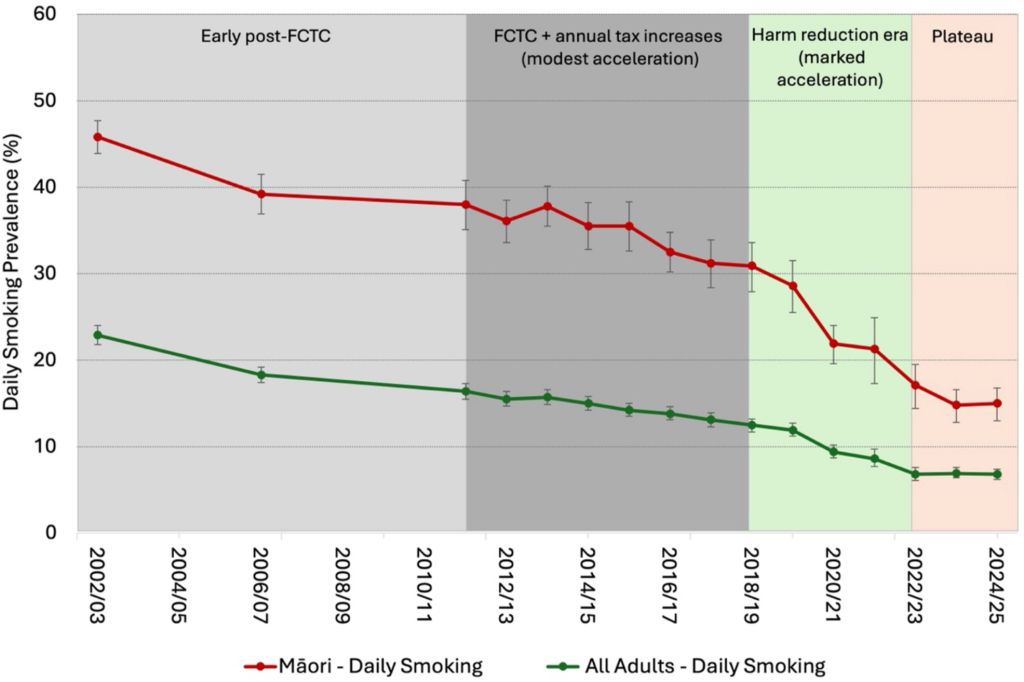
Allowing new nicotine products accelerated smoking cessation (souce: https://www.sciencedirect.com/science/article/pii/S2666606526000866)
Targeted progress where it matters
The most remarkable aspect of New Zealand’s harm reduction strategy is its impact on health equity. Historically, indigenous Māori communities faced severe health inequities, with smoking rates vastly exceeding those of non-Māori.
When vaping became widely accessible as a regulated consumer product, the most pronounced declines occurred precisely where the tobacco burden was heaviest. Among Māori adults, daily smoking rates halved in just six years, dropping at an accelerated rate of −13.3 percent annually post-2018. This massive shift directly addresses long-standing life-dependency and health gaps.
Concurrently, youth smoking has been virtually eliminated. Daily smoking among 14-to-15-year-olds has dropped to just 1 percent. While youth vaping initially spiked when the market was entirely unregulated, subsequent, proportionate legislation implemented in 2021, including age limits (18+), flavor restrictions, and caps on nicotine concentration, successfully brought regular youth vaping down from a peak of 20 percent in 2021 to 11 percent in 2025, without reversing the historic lows in youth smoking.
The European contrast: France’s prohibitionist stance
While New Zealand utilized innovation to combat combustible tobacco, much of Europe has taken a diametrically opposed route. Countries like France have increasingly leaned into heavily restrictive, prohibitionist strategies that treat less harmful alternatives with the same severity as lethal cigarettes.
France, which has historically struggled with stubbornly high smoking rates—where nearly a quarter of the adult population still smokes daily—has consistently treated vaping with suspicion. Rather than leveraging electronic cigarettes as a public health tool to pull smokers away from combustion, French policy has focused heavily on cracking down on alternatives. Recent legislative pushes have targeted flavor bans, sought to restrict retail access, and successfully banned disposable vapes altogether.
The core flaw in the Franco-European approach is the failure to decouple nicotine use from tobacco smoke harm. By treating vapes, nicotine pouches, and combustible cigarettes as a singular evil, these policies inadvertently protect the cigarette market. When the price differential between deadly cigarettes and safer alternatives is minimized, or when the accessibility and flavor appeal of alternatives are stripped away, entrenched smokers are left with fewer off-ramps.
As New Zealand’s neighboring contrast with Australia proves, where a prescription-only model for vapes led to a booming illicit black market and stagnant smoking rates, prohibition does not eliminate demand; it merely drives it into unregulated channels. France’s trajectory appears headed toward a similar trap, making it highly unlikely to achieve the rapid, equitable health gains seen in the South Pacific.
Lessons for global tobacco control
The data from New Zealand’s natural experiment offers key takeaways for international policymakers:
-
FCTC Measures are not enough: Traditional demand-reduction policies (taxes and packaging) are foundational but insufficient to rapidly achieve sub-5% smoking targets.
-
Harm reduction works at scale: Providing regulated, affordable, and accessible alternatives accelerates the transition away from combustible tobacco, particularly for highly dependent or marginalized populations.
-
Proportionate regulation is key: It is entirely possible to encourage adult smoking cessation through vaping while protecting youth via smart, enforced age and product restrictions.
Public health policy must ultimately prioritize the minimization of tangible harm over the moral pursuit of absolute nicotine abstinence. New Zealand met smokers where they were, offered them a compassionate, less harmful alternative, and achieved a public health miracle. It is a blueprint that Europe, France, and the rest of the world can no longer afford to ignore.




 EN
EN  SV
SV