

Tobacco policy is often judged by the restrictions it introduces. A more useful test should be to look at what happens to smoking afterwards. Smoke Free Sweden has published several reports on how different countries and their policies can impact smoking, nicotine use and the impact of cession on a county’s healthcare.
In their latest report, Power in a Pouch: Mexico, The Road to a Healthier, Smoke-Free Future, they examine nicotine pouch use through that lens. The central question of the report is simply: could regulated access to alternative nicotine products help Mexican adults move away from cigarettes?
The main findings come from a survey of 1,024 adult cigarette and nicotine product users in Mexico, conducted by Prodege between 15 and 27 July 2026. Among pouch users, 47 percent reported smoking slightly fewer cigarettes, 24 percent significantly fewer, and 6 percent no longer smoking at all. Together, these groups account for the report’s headline figure of 77 percent. The report also describes a fall in average daily cigarette consumption from ten to five after adopting pouches.
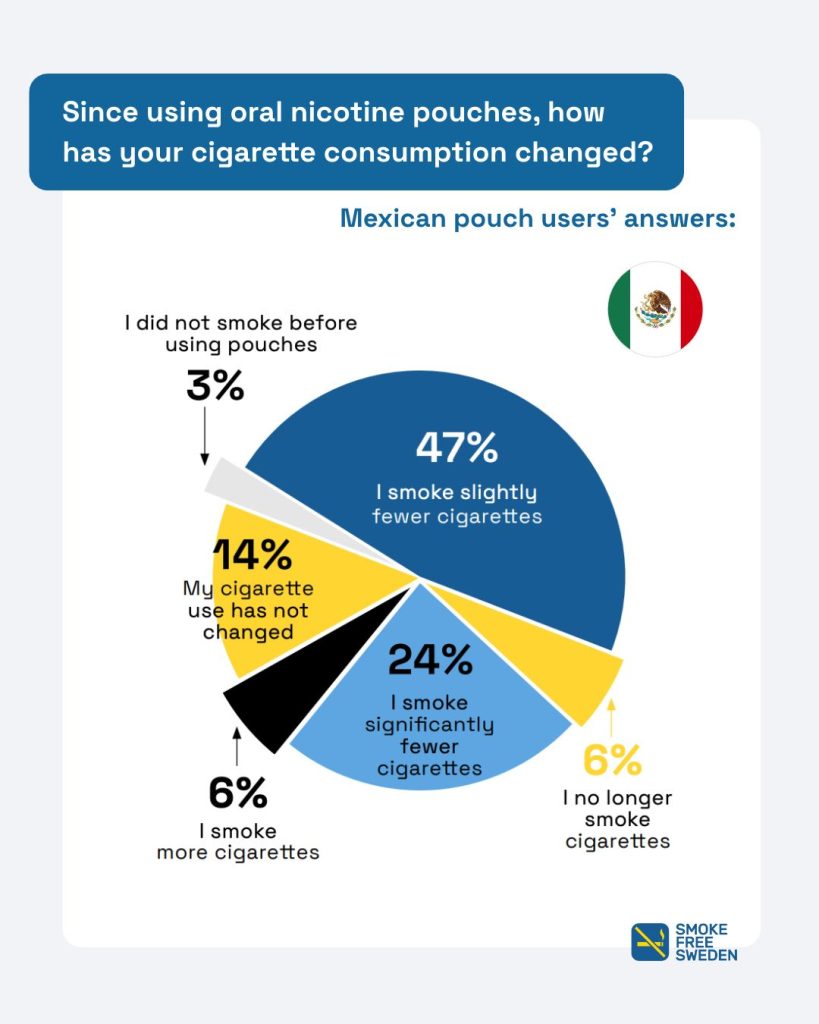
Nicotine pouches has has a strong impact on smoking in Mexico according to a survey from Smoke Free Sweden
The pros and cons
The picture is not all sunshine and unicorns. Fourteen percent reported no change in cigarette consumption, while 6 percent actually said they smoked more. A further 3 percent said they had not smoked before using pouches. This is significant since it connects to one of the anti-nicotine lobby’s main arguments; that nicotine pouches and vapes are gateways to smoking. But comparing the 3 percent with the numbers of people quitting or reducing smoking, it seems like a relatively small issue.
The health argument rests on the proven assumption that delivering nicotine without burning tobacco avoids exposure to cigarette smoke. It is a fact that a total of 8 million people die every year from smoke-related illness. But nicotine remains addictive, and pouches are not risk-free. The US Food and Drug Administration describes them as a generally lower-risk alternative for adults who smoke, while stressing that switching completely is important to obtain the full benefit. Young people and adults who do not use tobacco products should not start. (FDA)
The Mexican survey is particularly informative about what users find practical. Convenience, being able to use pouches without disturbing others, perceived lower risk and flavor variety all featured prominently. Seventy-four per cent of pouch users rated flavors as very or extremely important. These preferences help explain product appeal. This is also why the industry fights for the right to flavor the products with whatever people like. And in reverse, why the anti-nicotine lobby fights for banning all flavors except perhaps mint.
Regulation or not – ’tis the question
On regulation, 71 percent of respondents supported sales subject to age restrictions, product standards and labelling requirements. Opposition to an outright ban stood at 47 percent, compared with 24 percent of respondents in favor of one. These are the views of surveyed cigarette and nicotine consumers, rather than a measure of Mexican public opinion as a whole.
Asked about a hypothetical ban, 19 percent of pouch users said they would return to smoking and 13 percent would smoke more. Only 4 percent said they would stop using nicotine altogether. Intentions are not predictions, but they raise a reasonable concern: removing a product does not necessarily remove demand for nicotine. Behavior has a habit of ignoring the neatness of legislation.
The report recommends regulated adult access, product standards, clearer risk information and stronger smoking cessation services. Its survey supports further investigation of that approach, rather than a promise of a particular outcome. The practical test would be whether regulation helps adults stop smoking while limiting uptake among young people and non-users. That requires following what people actually do, not merely counting what policymakers have prohibited.


 EN
 SV