

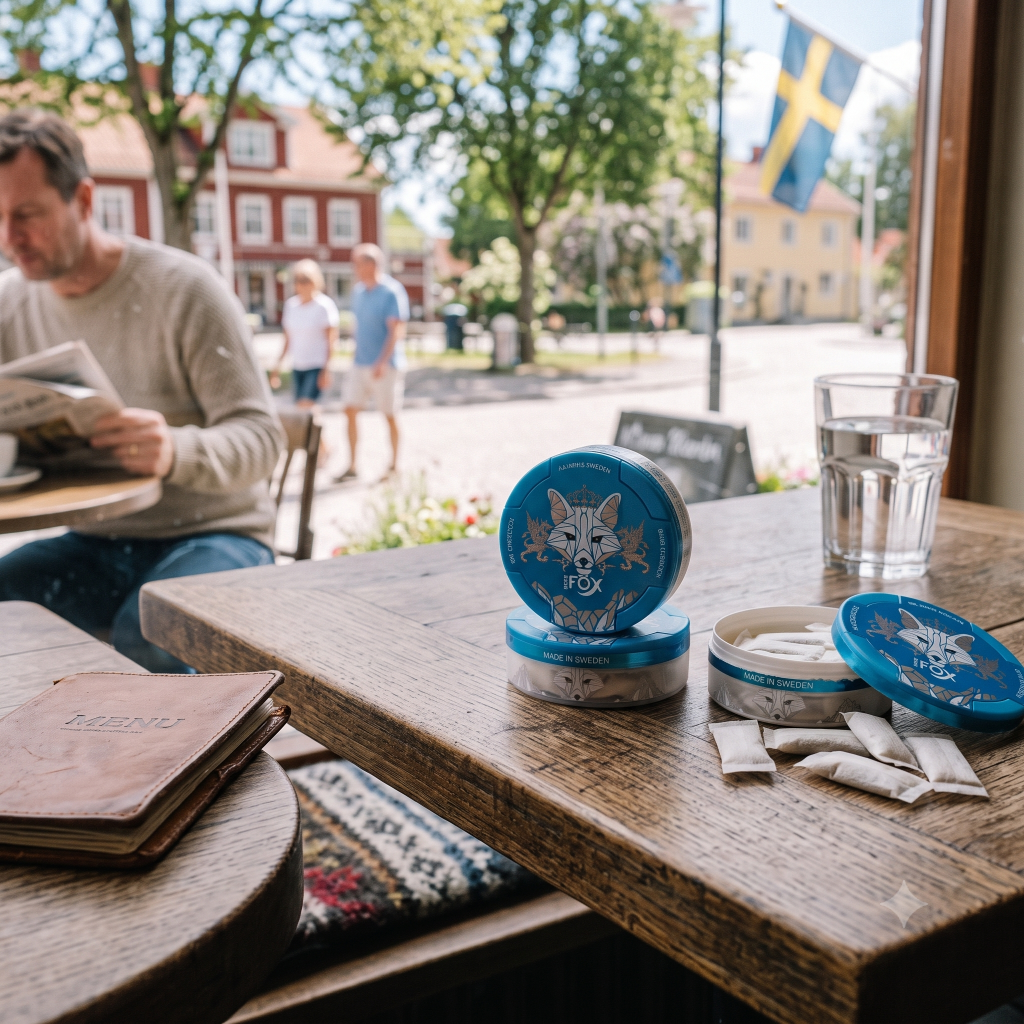
If you live in Sweden, snus is hardly something that needs explaining. It is in people’s pockets, on shop counters and in everyday conversation. We know what a round tin is. We know what someone means when they say they are “having a prilla”.
Outside Sweden, it is different. Snus and nicotine pouches are often seen as strange new products, or simply confused with chewing tobacco. The confusion matters, because the products are not the same—and neither are their risks, rules or potential place in helping smokers move away from cigarettes.
Here is a straightforward guide.
First: snus and nicotine pouches are not the same thing
Traditional Swedish snus contains tobacco. It is a moist oral tobacco product, sold either loose or in small portion pouches. A user places it under the upper lip, where nicotine is absorbed through the lining of the mouth.
Nicotine pouches look similar and are used in the same way, but they do not contain tobacco leaf. They are often called “white snus”, especially in Sweden, but that is a marketing and everyday term rather than a precise description. Outside Sweden, “nicotine pouch” is the clearer name.
Both are smokeless. Neither is burned. Neither produces smoke for the user or for people nearby. They are also generally spit-free, unlike some other forms of smokeless tobacco. That does not make them identical, or harmless. It does mean they should not be judged as if they were cigarettes.
How traditional Swedish snus is made
Swedish snus has a long history from when farmers grew their own tobacco and made their own snus in their own kitchens. Modern production is carefully controlled. It begins with tobacco leaves, usually dried and ground into a fine powder. Water and salt are added, along with pH-regulating ingredients to control how fast the nicotine is absorbed, moisture-preserving substances and flavorings, for example peppermint oil.
The mixture is then heat-treated in a process similar to pasteurisation. This is an important difference between Swedish snus and some other traditional smokeless tobacco products, which may be fermented instead. Heat treatment reduces microbial activity and helps create a more consistent product with a longer shelf life.
Once cooled, the snus is tested, flavored and packed into tins. Portion snus is placed in small porous pouches; loose snus is sold as moist tobacco that the user shapes by hand.
Much Swedish snus is still made in Sweden. Major production has historically been centered around Gothenburg, Kungälv and Enköping, cities with long ties to the industry. But the name “Swedish snus” should describe a type of product and tradition, not automatically guarantee where every tin was made. The label is the best place to check country of origin and ingredients.
How nicotine pouches are made
Nicotine pouches are newer and simpler in one important respect: there is no tobacco leaf in the pouch. Except in a product like Bulldog which contains a tiny amount of tobacco to make it legal to sell there.
Instead, manufacturers use a plant-fibre filling, often cellulose, and combine it with nicotine, water, flavorings, and ingredients that control pH and moisture. The nicotine may be extracted from tobacco or made synthetically. From the user’s point of view, the nicotine molecule works in much the same way either way. But in the US, only synthetical nicotine is used.
The mixture is placed in small fibre pouches and packed in tins. A pouch may be dry, moist, slim, regular or mini. Nicotine levels also vary greatly between products and countries. Usually, they range from 4 mg up to 30 mg or more. But the experience is greatly impacted by the pH level which controls how fast the nicotine is absorbed.
The format has Nordic roots, but nicotine pouches are now made in Scandinavia, elsewhere in Europe, North America and beyond. That makes it even more important not to assume that every product called “white snus” follows the same manufacturing standards or rules.
How are they used?
The normal way to use both snus and nicotine pouches is simple:
- Place one pouch between the upper lip and gum.
- Leave it there while nicotine and flavour are released.
- Remove it when finished and dispose of it in a bin or in the compartment inside the lid of many tins.
They are not meant to be smoked, heated, chewed or swallowed.
A new user may feel a tingling sensation in the gum. Stronger products can also cause nausea, hiccups, dizziness, headache or a racing heartbeat—especially for someone with little experience of nicotine. If that happens, remove the pouch.
As with all nicotine products, tins should be kept away from children and pets. A pouch can contain enough nicotine to make a child seriously ill.
What do they do?
Nicotine is absorbed through the mouth and reaches the bloodstream without smoke entering the lungs. Users may experience a temporary feeling of alertness, calm or satisfaction. For regular users, however, much of that feeling is also relief from nicotine withdrawal.
The central fact is that nicotine is addictive. Dependence can develop, and stopping can bring cravings, irritability, restlessness and difficulty concentrating.
Nicotine can also temporarily raise heart rate and blood pressure. It is not appropriate for children, adolescents or pregnant people. People with cardiovascular disease, high blood pressure or other health concerns should speak to a healthcare professional rather than assume a pouch is risk-free.
Local effects matter too. Some users experience gum irritation, soreness, dry mouth or changes where the pouch is repeatedly placed. Moving the pouch around and stopping if irritation persists is sensible.
The main benefit: no combustion
The strongest argument for snus and nicotine pouches is not that nicotine is healthy. It is that cigarettes are uniquely dangerous because tobacco is burned.
Cigarette smoke contains thousands of chemicals, including many known to cause cancer. It also exposes the smoker to carbon monoxide and fine particles that damage the lungs and cardiovascular system. Snus and nicotine pouches do not involve combustion, smoke or inhalation into the lungs.
For an adult smoker who switches completely from cigarettes to a smokeless product, this can reduce exposure to many harmful substances. The word “completely” matters. Using pouches while continuing to smoke may be more convenient, but it does not remove the main danger of cigarettes.
The US Food and Drug Administration has authorised a limited modified-risk claim for specific ZYN pouch products: using those products instead of cigarettes puts users at lower risk of several smoking-related diseases. That decision applies to named products and to switching from cigarettes; it is not a declaration that every pouch is safe or that non-users should start. FDA’s decision is worth reading in full.
The drawbacks and unanswered questions
The absence of smoke does not mean the absence of risk.
Traditional snus still contains tobacco and nicotine. Nicotine pouches avoid tobacco leaf, but they still deliver an addictive drug and may contain high nicotine doses. Long-term evidence on nicotine pouches is still limited because the products are comparatively new. We should be honest about that rather than fill the gaps with either alarmism or wishful thinking.
There is also a public-health question that goes beyond the individual smoker. A pouch may be a better alternative for someone who would otherwise smoke cigarettes. It is not a health product for someone who would otherwise use no nicotine at all. But for those smoking today, switching to snus or nicotine pouches clearly reduces the risk of a range of serious and potentially lethal health issues.
Can you travel with snus or nicotine pouches?
The rules differ sharply between countries, and they change. The fact that a product is legal to buy in Sweden does not mean it is legal to sell, import, possess or use elsewhere.
Within the European Union, tobacco snus is subject to a long-standing ban on being placed on the market, with Sweden as the exception. In plain language: tobacco snus cannot generally be sold in other EU member states. The EU rule concerns commercial sale, not a single, Europe-wide rule on personal possession. But national customs rules, distance-sales rules and enforcement can differ, so travellers should check the destination country’s official advice before packing a tin. The relevant EU rule is Article 17 of the Tobacco Products Directive.
Nicotine pouches are regulated separately, and the picture is even less consistent.
France is the clearest example. Since 1 April 2026, nicotine pouches and other non-medical oral nicotine products have been prohibited there. The French government describes this as a ban on use, acquisition, possession and sale, among other activities. This is not merely a theoretical issue for travellers: bringing pouches into France can create a legal problem, even if the likelihood of enforcement in an individual case is impossible to predict. France’s official notice is here.
Elsewhere, the rules vary:
- In the United Kingdom, the commercial supply of tobacco snus has been banned since 1992.
- In Norway, traditional snus has a special legal position, while tobacco-free nicotine pouches face strict restrictions, including limits on bringing them into the country.
- In Australia, the commercial import and sale of oral tobacco products such as snus is illegal.
The practical lesson is dull but important: check the customs authority, health authority or embassy website for the country you are visiting. Do not rely on what a shop, social-media post or online forum says.
A Swedish perspective, without assuming the whole world is Swedish
For many Swedes, smokeless nicotine is familiar enough to be almost invisible. But viewed from outside, the distinction is worth making.
Snus is a tobacco product with a particular Swedish history and production method. Nicotine pouches are tobacco-free products that use the same discreet format. Neither is harmless. Both are very different from smoking.
For adults who smoke cigarettes, switching completely to a smokeless alternative may be a meaningful harm-reduction choice. For people who do not use nicotine, there is no good reason to begin. And for anyone travelling, the small tin in a pocket may carry more legal weight than it does at home.
That is the Swedish experience in its most useful form: not a claim that every nicotine product is good, but a reminder that how nicotine is delivered matters greatly. Removing smoke from the equation makes all the difference.



 EN
EN  SV
SV